

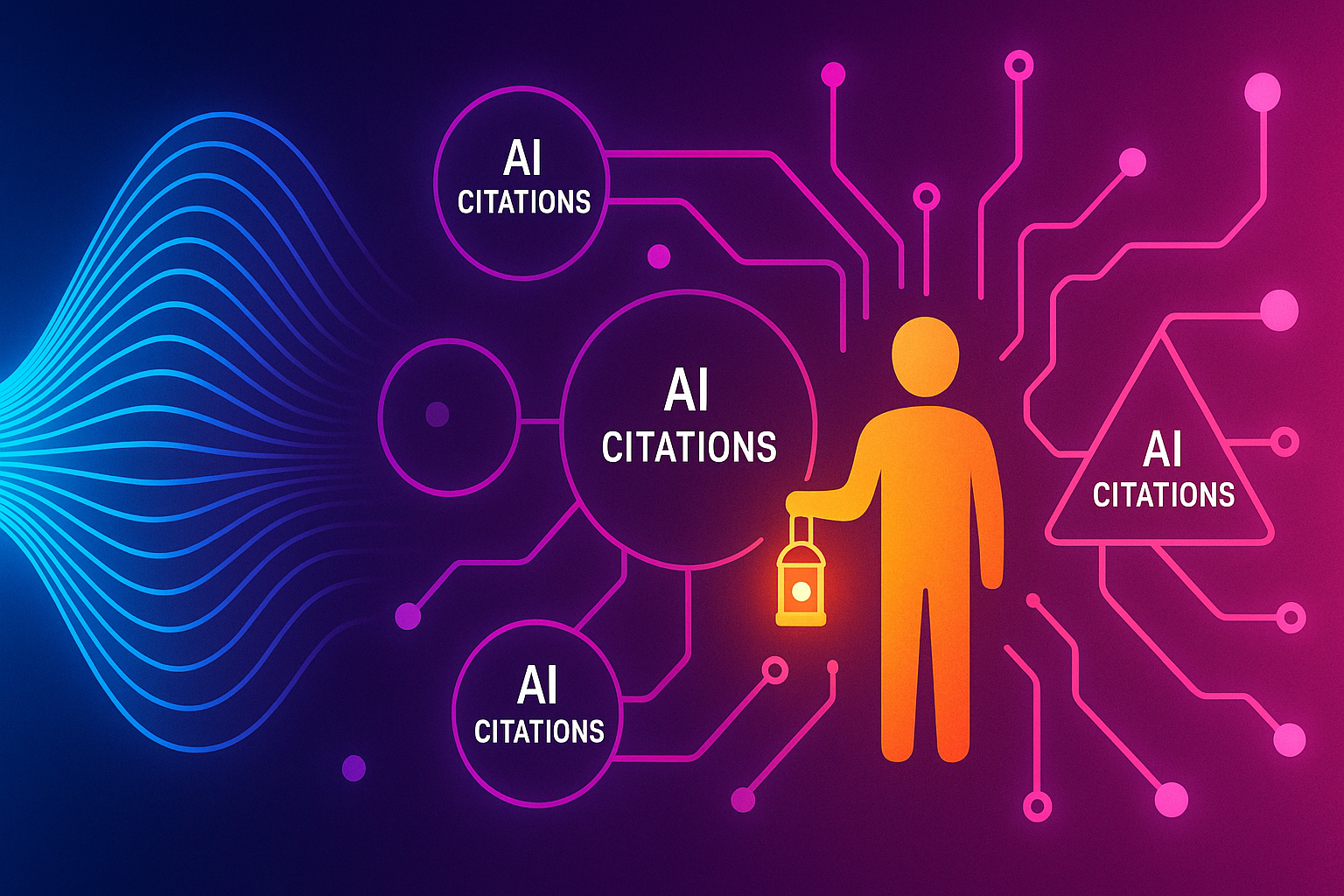
Single most important news this week: Generative Engine Optimization (GEO) and AI‑agent decisioning have moved from niche tactics to core marketing infrastructure — meaning AI systems now decide who gets seen and how ads are served. For digital marketing leaders this matters because survival and growth will depend less on legacy SEO or ad impressions and more on being cited by AI, owning clean first‑party data, and delivering human stories that AI preserves rather than dilutes.
TL;DR
- AI agents and decision engines are making real-time personalization the new baseline.
- Generative Engine Optimization (AEO/GEO) — being cited by AI — is essential for discovery.
- Platforms are monetizing conversational interfaces: conversational ads and new adtech deals change inventory and measurement.
- Invest in first‑party data, deliverability and real‑time orchestration (RevOps) as defensive priorities.
- Human storytelling, trust and creative curation become the premium differentiators as AI commoditizes execution.
Change Summary
Across the week’s headlines the structural story is clear: AI is no longer an optional productivity layer — it is the fabric of discovery, personalization and ad inventory. Autonomous agents and decision engines are replacing static rules and scheduled campaigns, generative answer engines are compressing journeys into zero‑click moments, and major platform/adtech moves are turning conversational interfaces into monetizable ad surfaces. Practically, this forces marketers to redesign measurement (outcome‑focused, privacy‑safe events), invest in real‑time data and orchestration, and make first‑party signals (clean CDPs, deliverability, entity clarity) the backbone of visibility.
Second‑order effects reshape organizations, vendor economics and creative practice. Teams will increasingly prize systems‑design skills (prompt/agent engineering + RevOps + creative leads) over siloed specialists; agencies will compete on measurement, data architecture and outcome guarantees instead of impressions; and production‑led models will scale creative output while elevating human curation as the premium differentiator. These shifts are probable because platforms both control discovery and have commercial incentives to monetize it — meaning visibility is now a product design problem, not only a promotional tactic. For marketers and entrepreneurs this raises the payoff for investing in governance, experimentation capability, and distinct human storytelling that AI will cite rather than simply echo.
Change Patterns
What changed recently: AI advanced from an assistive tool to structural infrastructure — agentic personalization and AI decisioning now choose channels, timing and creative in real time, while generative answer engines compress discovery into zero‑click, citation-driven moments. Platforms and adtech players are rapidly monetizing those conversational and generative surfaces (new ad products, partnerships and agentic ad tooling), which rewrites where attention lives and how campaigns must be bought and measured.
What has stayed a trend: the defensive value of owned channels (email, communities, first‑party data), the premium on trust/E‑E‑A‑T and creative quality, and the rising importance of measurement maturity (RevOps, real‑time analytics, outcome KPIs). Week after week the guidance repeats: secure your data and inboxes, invest in AI‑readable authoritative content, and pair automation with human oversight.
Interesting patterns and likely next steps: (1) Two‑speed market: organizations that rebuild operating models around AI infrastructure (data pipelines, agent governance, outcome measurement) will widen their lead over bolt‑on adopters. (2) Platform monetization creates counter‑moves: as AI intermediates visibility, brands double down on authority signals (video/YouTube, structured entities, reviews) and owned channels to regain predictable reach. (3) Talent and product shifts: demand will surge for ‘system designers’ (prompt/agent engineers + RevOps + creatives) and for agencies that can promise measurable outcomes, not just creative deliverables. These patterns reinforce one another and suggest durable structural change rather than a transient fad — the competitive frontier moves from doing AI to operating with AI ethically, measurably and creatively.
Topic Clusters
Agentic AI & Real‑Time Decisioning
- How AI Agents Optimize Cross-Channel Engagement in Real-TimeHow AI Agents Optimize Cross-Channel Engagement in Real-Time: The article explains that autonomous AI agents unify customer data, act on live behavioral signals, and automatically choose the best channel and timing to deliver personalized messages without manual intervention. Unlike scripted chatbots or scheduled automations, these agents perform real-time arbitration—scoring channels and priorities to prevent over-messaging—enabling dynamic personalization, improved engagement, and greater operational efficiency for marketing and creative teams.
- How Agentic AI Changes Customer Journey OrchestrationHow Agentic AI Changes Customer Journey Orchestration: Agentic AI autonomously understands context, plans and executes cross-channel customer journeys in real time using live data instead of fixed rules. It operates within brand, compliance and margin guardrails, logs actions for governance and optimization, and adapts journeys dynamically—positioning it as a step-change versus traditional rule-driven orchestration tools.
- AI Decision Engines: The Brain Behind Personalized ExperiencesAI Decision Engines: The Brain Behind Personalized Experiences — AI decision engines function as a real-time brain that converts predictions into the best next action for each customer by combining machine learning with business rules to optimize timing, channel, and offers while respecting constraints. They can suppress low-value actions, prioritize uplift (not just propensity), and validate effectiveness via incremental lift.
Generative Engine Optimization (AEO/GEO) & AI Visibility
- What Is Generative Engine Optimization (GEO) and Why It MattersWhat Is Generative Engine Optimization (GEO) and Why It Matters: The article warns that online visibility is shifting from traditional search results to single, AI-generated answers, meaning brands not included in those outputs risk becoming invisible. It introduces Generative Engine Optimization (GEO) as the set of practices marketers must adopt to ensure content is surfaced, cited, and trusted by generative AI systems — emphasizing the need for authoritative, structured, and AI-friendly content, updated workflows for creative and SEO teams, and ongoing measurement of brand presence in chatbot responses.
- AI visibility score: How to summarize your AI visibilityAI visibility score: How to summarize your AI visibility — The article argues that an “AI visibility score” captures a brand’s presence in AI-driven search and answer surfaces that traditional SEO rank tracking misses. It says monitoring this score is becoming as essential as tracking Google rankings but is harder to measure, and points readers toward new AEO/AI tools (the article includes a HubSpot CTA).
- How to Optimize Content for ChatGPT: An AI Discovery GuideHow to Optimize Content for ChatGPT: An AI Discovery Guide: Notes that while Google still dominates search, the rise of AI-driven alternatives like ChatGPT is prompting marketers to rethink content optimization strategies to remain discoverable and effective.
Adtech, Platform Monetization & AI as New Inventory
- Goodway Group and Optable Partner to Feed AI Agents on Cleaner DataGoodway Group and Optable Partner to Feed AI Agents Cleaner Data — as AI agents rapidly enter ad tech, the partnership aims to improve data cleanliness at a time when agencies are still struggling to fix and standardize their data.
- Fox Just Gave Its Ad Portfolio a Massive AI UpgradeFox Just Gave Its Ad Portfolio a Massive AI Upgrade — Fox has launched Fox AdStudio, a new platform designed to simplify and surface AI-driven insights across its media properties for advertisers.
- PayPal Goes After Streaming TV Advertisers With New Adtech DealsPayPal Goes After Streaming TV Advertisers With New Adtech Deals — The financial firm is partnering with Spectrum Reach, Tubi, and Warner Bros. Discovery to pursue advertising opportunities in streaming TV.
Creative Production, Creator Economy & Brand Partnerships
- 3,000 Images, Zero Dialogue: How This Studio Made AI Films Without Sacrificing the Creative Soul3,000 Images, Zero Dialogue: How This Studio Made AI Films Without Sacrificing the Creative Soul — Purga Films and agency Gut produced three AI-generated short films (built from thousands of images and no spoken dialogue) and distilled practical lessons about collaborating with AI tools while preserving human-led storytelling, creative intent, and production workflows.
- VaynerX Launches Tamara Group, Betting Production-Led Is the New Agency ModelVaynerX Launches Tamara Group, Betting Production-Led Is the New Agency Model — VaynerX has launched Tamara Group, a production-led agency model, signing clients including Ulta Beauty, Mrs. Meyer’s, and Method. The move emphasizes a production-first approach intended to streamline content creation and scale creative output for brand clients.
- PR Meets Influence: The New Engine of Brand GrowthPR Meets Influence: The New Engine of Brand Growth — Advocates building long-term creator relationships and prioritizing the measurement of cultural impact to shift influencer efforts from transactional campaigns to sustained brand growth, urging integration of PR and influencer strategies and metrics that capture cultural resonance.
Owned Channels, Measurement & Conversion (Email, Analytics, RevOps)
- Increasing Conversions: Quick Wins That Work in 2026Increasing Conversions: Quick Wins That Work in 2026 — The article explains why conversion rates have stalled this year (including silent erosion of email databases and common landing-page mistakes) and offers practical, fast-implement tactics for reversing the trend. Recommendations focus on repairing list health and first‑party data capture, simplifying landing‑page UX and CTAs, reducing friction and load times, improving segmentation/personalization, and instituting rapid testing so marketing managers and creative teams can regain conversion momentum quickly.
- Draft, Send, and Analyze. All From ChatGPTDraft, Send, and Analyze. All From ChatGPT: AWeber announced an app in the ChatGPT App Marketplace that lets users connect their AWeber account to ChatGPT to draft broadcasts, manage subscribers, and view interactive analytics directly inside chat. Key features include one-click connection, in-chat drafting and audience queries, and visual widgets (list tables, subscriber cards with engagement history, sent-broadcast lists, and broadcast performance graphs) to streamline email marketing workflows.
- 8 Best E-commerce Analytics Software I Recommend for 20268 Best E-commerce Analytics Software I Recommend for 2026 — A brief roundup recommending eight e-commerce analytics tools aimed at helping marketing and e-commerce teams cut through measurement complexity. The article addresses common pain points (understanding conversion-rate shifts, drops in bestseller categories, and spikes in cart abandonment) and positions recommended software as solutions to replace or consolidate multiple unclear tools.
